The AI-Guided
Legal Education Engine
Behind Smarter, Stronger,
More Disciplined Legal Action
Mega Lawfare’s Legal Education System is being built to train ordinary Americans in procedure, evidence, objections, filings, research, courtroom preparation, and real-world legal discipline through bite-sized daily lessons, accelerated memory methods, AI-guided mentoring, quizzes, simulations, and mobile reinforcement.
Legal Education
Engine
The AI-Guided Legal Education Engine
Behind Smarter, Stronger,
More Disciplined Legal Action
Mega Lawfare’s Legal Education System is not a generic library of articles. It is a structured legal training architecture designed to help ordinary people learn procedure, evidence, objections, filings, strategy, and real-world legal discipline through guided lessons, quizzes, simulations, retention systems, and mobile reinforcement.

Why Mega Lawfare Legal Education Is Different
Most legal education available to ordinary people is fragmented, passive, and hard to apply under pressure. Mega Lawfare is building a more operational model, one that teaches the rules, reinforces the rules, tests recall, and helps users execute what they have learned in real-world situations.
Structured, not scattered
Members move through an organized curriculum instead of bouncing between random articles, videos, and disconnected legal tips.
Built for retention
The system uses repetition, recall, quizzes, and gamified reinforcement so the knowledge stays with the learner instead of evaporating after one reading.
Tied to action
Training is connected to filings, evidence, hearings, rights defense, public accountability, and real procedural follow-through.
Integrated with AI and mobile systems
The education layer works with Mega-Bot and the Mobile Command App so the member can learn, rehearse, and act inside one connected ecosystem.
A Coordinated Legal Education System,
Not Just a Course Library
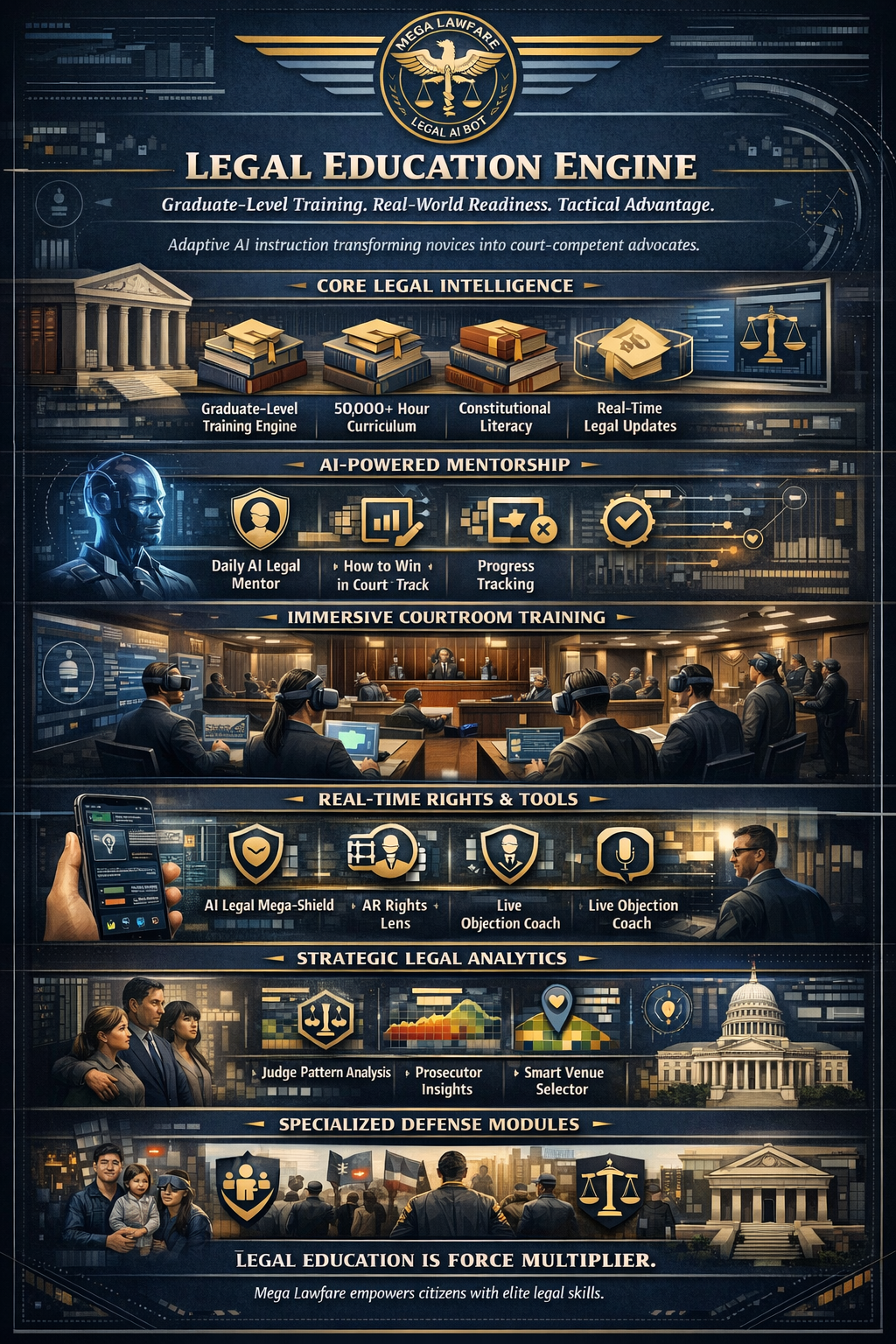
Mega Lawfare’s education architecture is designed to combine graduate-level legal training, a large authoritative curriculum repository, Daily AI Mentor guidance, “How to Win in Court” instruction, simulation, constitutional literacy, accelerated memory methods, and real-time mobile reinforcement.
The How to Win in Court Curriculum, Rebuilt and Expanded
Mega Lawfare is reworking and modernizing the strongest parts of the classic “How to Win in Court” training model, then integrating them into a deeper AI-guided education system with more repetition, more structure, more simulations, and more real-world reinforcement.
Foundations of Law
Natural law, constitutional principles, jurisdiction, standing, due process, separation of powers, legal maxims, burdens, presumptions, and the basic architecture of lawful authority.
Civil & Criminal Procedure
Filing sequence, service, pleadings, answers, motions, hearings, deadlines, rules of court, preserving the record, and the procedural traps that decide cases before facts are ever heard.
Evidence & Objections
Relevance, admissibility, hearsay, authentication, foundations, documentary evidence, witness handling, trial objections, and how to preserve evidentiary error for later review.
Pleadings, Motions & Affidavits
Complaints, answers, affirmative defenses, declarations, affidavits, show-cause filings, summary judgment responses, emergency motions, and persuasive legal writing.
Discovery & Compelling Evidence
Requests for production, interrogatories, subpoenas, records requests, preservation demands, compelling evidence, exposing contradictions, and building usable proof.
Trial Prep & Appellate Readiness
Issue framing, witness preparation, exhibits, timelines, argument structure, objections under pressure, appealable error spotting, and post-judgment strategy.
Legal Research & Citations
How to find controlling authority, use rules and statutes, read cases, build citation discipline, and structure legal arguments with credibility and precision.
Specialized Tracks
Foreclosure, property disputes, family court, custody, civil rights, public accountability matters, administrative processes, and other high-impact citizen-facing areas.
Enforcement & Judgment Follow-Through
What happens after a ruling, including enforcement strategy, compliance pressure, judgment collection basics, records follow-up, and procedural persistence.
The Closest Thing to an Honorary Law Degree
for Ordinary Americans
The goal is not to overwhelm members with legal jargon. The goal is to build real legal competence over time through bite-sized daily lessons, audio, video, reading, writing, quizzes, memory drills, scenario practice, and progressive skill-building that compounds.
AI-Guided Reinforcement, Gamification, and Recall Training
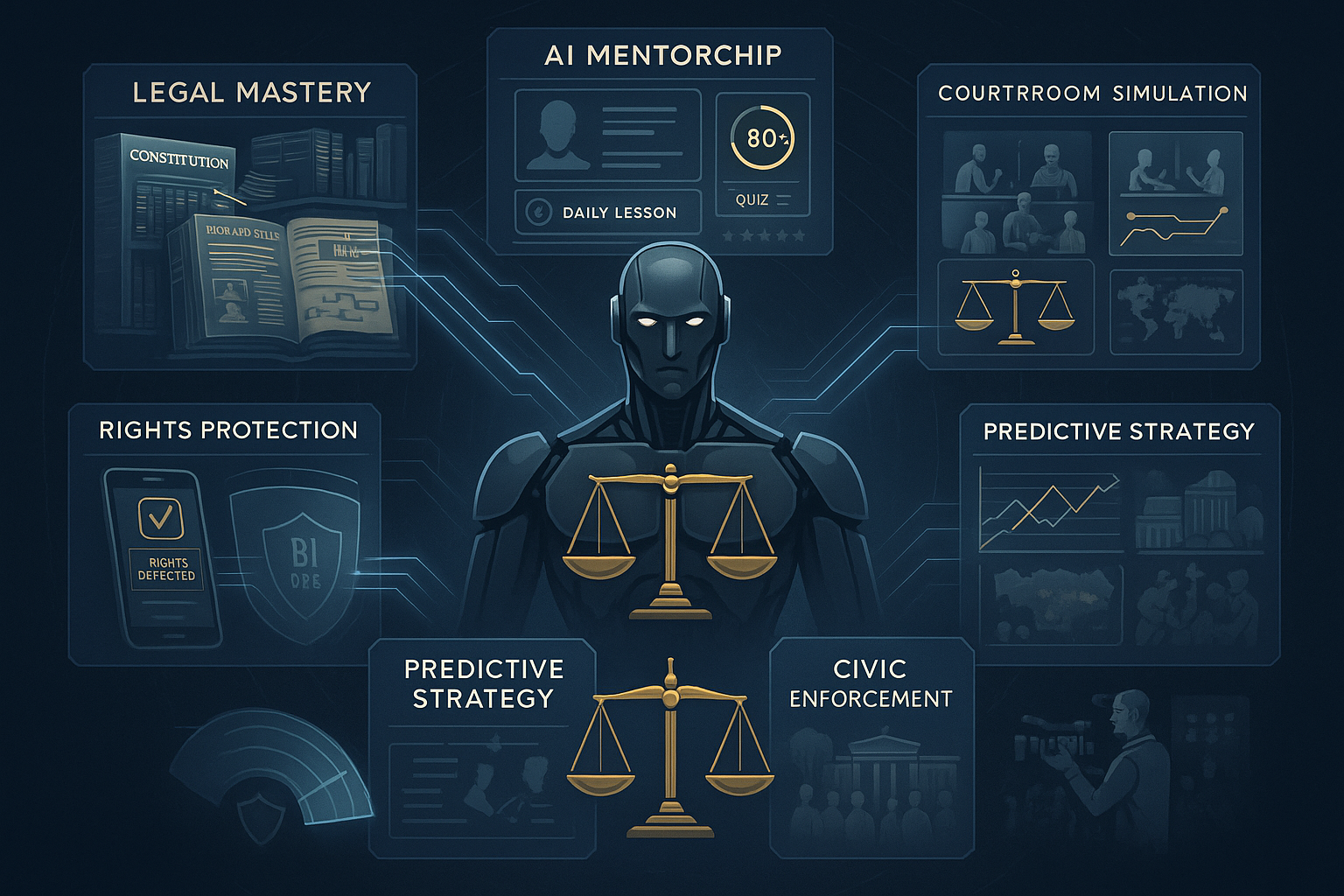
A major advantage of the Mega Lawfare education system is that it is designed to keep teaching after the lesson ends. Instead of one-time content consumption, the system can reinforce what members are learning through repeated exposure, short quizzes, milestone celebrations, and live reminders.
Legal Knowledge Is Useless If You Cannot Recall It Under Pressure
Mega Lawfare’s education system is meant to train legal performance, not just legal familiarity. Members should be able to recall rules, objections, procedures, and strategic responses when the pressure is real, whether in court, during a public encounter, or while drafting under time constraints.
Spaced repetition
Critical legal concepts are reintroduced at the right intervals so retention compounds instead of decays.
Active recall drills
Members are asked to retrieve rules, procedures, and responses from memory rather than passively reread them.
Stress simulation
Training includes pressure-based scenarios so performance improves under the same kind of tension people face in real legal encounters.
Pre-action readiness
Members can receive quick refreshers before filings, hearings, testimony, public encounters, or other moments that require precision.
The Education System Extends Into the Mobile Command App
Mega Lawfare’s training does not stop at the desktop. The Mobile Command App is designed to carry the education system into the field, into hearings, and into live encounters by reinforcing what the member has already learned and helping them apply it in context.
Live legal coaching
Members can receive reminders on objections, rights language, evidence preservation, and procedural awareness during live situations.
Scenario-linked education
The app can tie specific training modules to courtroom hearings, police interactions, affidavit preparation, preservation letters, or case follow-up tasks.
AR and field overlays
As the system evolves, the app roadmap includes legal overlays, rights cues, and tactical prompts during high-pressure interactions.
Court debrief learning loops
After hearings or encounters, the app can help members review what happened, spot missed opportunities, and feed that experience back into training.
Short daily reinforcement on mobile
Members can complete quizzes, lesson bursts, and mastery checks from their phones so training continues consistently.
Action-ready document awareness
The education system can connect directly to real drafting workflows, helping members understand what they are filing and why it matters.
Major Training Capabilities Across One Coordinated Legal Education System
This section is designed to visually echo the modular structure of your Legal AI page while showing the deeper architecture of the education program itself.
1. Foundations, Constitutional Literacy, and Legal Frameworks
- Constitutional structure, rights, and limits on government power
- Natural law, due process, standing, jurisdiction, and procedural fairness
- Basic legal maxims, burdens, presumptions, and lawful authority
- How courts, agencies, clerks, prosecutors, and judges actually fit together
2. Procedure, Filings, Pleadings, and Motion Practice
- Complaints, answers, affirmative defenses, counterclaims, and amendments
- Motions, emergency filings, show-cause procedures, declarations, and affidavits
- Service, deadlines, formatting, court rules, and procedural sequence
- Strategic issue framing and preserving viable claims from the start
3. Evidence, Objections, and Courtroom Performance
- Foundations, authentication, hearsay, relevance, and admissibility
- Trial objections and preserving evidentiary error
- Witness handling, documentary exhibits, and courtroom discipline
- Practical courtroom strategy and argument sequencing
4. Legal Research, Citation Discipline, and Argument Building
- How to read rules, statutes, and controlling cases
- How to structure a legal argument that is clear, persuasive, and disciplined
- Basic citation habits, source credibility, and issue-based research workflows
- Linking facts to legal elements and proof requirements
5. Discovery, Preservation, and Compelling Evidence
- Requests for records, subpoenas, interrogatories, and production demands
- Evidence preservation, timeline building, contradictions, and proof assembly
- How to compel evidence and expose gaps in the other side’s story
- Preparing court-usable packets rather than random document piles
6. Daily AI Mentor, Quizzes, Gamification, and Recall Systems
- Short daily lessons and adaptive training tracks
- Text-message quizzes, pop quizzes, reminders, and progress prompts
- Levels, milestones, recognition, and achievement-based progression
- Accelerated learning and memory reinforcement methods
7. Simulation, Adversarial Practice, and Strategic Readiness
- Courtroom strategy simulation and mock adversarial scenarios
- Hostile judge and prosecutor behavior preparation
- Stress-based decision practice and issue-spotting under pressure
- Swarm drill training for coordinated readiness and timing
8. Mobile Command Reinforcement and Field Education
- Mobile education prompts during live encounters and hearings
- Objection reminders, rights cues, and procedural awareness in real time
- Post-hearing debriefs and app-driven learning loops
- Education tied directly to evidence capture, reporting, and follow-up action
9. Specialized Legal Tracks and Public-Need Training
- Foreclosure, mortgage, property, and title-related training paths
- Family court, custody, and parent-defense modules
- Civil rights, government misconduct, and citizen-journalist readiness
- Public accountability, administrative process, and escalation training
From Beginner to Operationally Ready
The education system should feel like a guided progression, not a random pile of resources. This framework helps visitors understand how they grow through the system.
Foundational Literacy
Learn rights, core legal vocabulary, constitutional structure, court basics, and the procedural map.
Procedural Competence
Understand how to preserve issues, structure filings, follow rules, and avoid common early mistakes.
Applied Tactical Training
Practice objections, evidence handling, research, scenario drills, and strategic issue framing.
Advanced Guided Readiness
Move into simulations, mobile reinforcement, pressure testing, and coordination with the wider Mega Lawfare system.
Enter the Training System That Turns Knowledge Into Capability
Mega Lawfare is building a legal education engine designed to help ordinary Americans understand the system, remember the rules, and act with more confidence, precision, and discipline. Join now to help build the curriculum, AI mentor systems, simulations, mobile reinforcement, and public-interest legal training infrastructure behind Mega Lawfare.